What do a finance professor turned cosmic guardian and a royal heir thrust into a desert war have in common? More than you might think.
As I reread Dune while finishing Guardians for the Celestial Nexus, I realized something: both Paul Atreides and Lewis Lambert ride emotional rollercoasters that echo classic mythic structures—rising from confusion to clarity, from despair to purpose. But while their trajectories may run parallel, their modes of leadership and sources of resilience differ in fascinating ways.
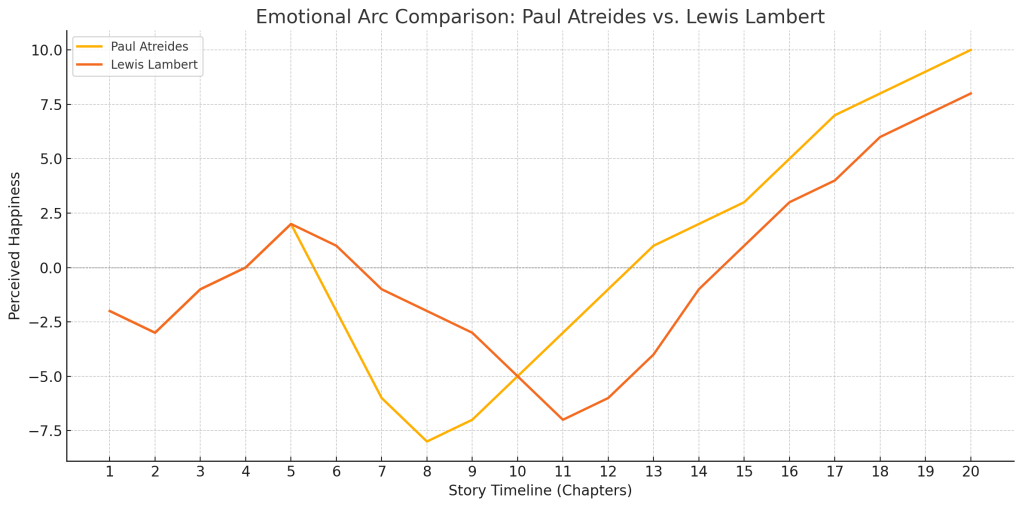
Below is a comparison of their emotional arcs across the course of their respective stories:
The Descent: Pain as Catalyst
In the first third of each novel, both Paul and Lewis wrestle with forces beyond their control. Paul is trapped in a political game he doesn’t yet understand. Lewis, though older and more experienced, is similarly caught in a multidimensional struggle whose full scope eludes even him.
The middle chapters mark their lowest points. For Paul, this is the fall of House Atreides, exile to the desert, and the loss of his father. For Lewis, it is the death of Chen Wei, a friend and colleague, that sends emotional shockwaves through the team and fractures their morale.
Both men face what all heroes must: the void. And they emerge transformed.
The Rise: From Mourning to Meaning
After the collapse, Paul and Lewis begin a slow but steady ascent—not just in power, but in purpose.
Paul’s climb is steep and solitary. He steps into his role as a messiah figure, increasingly driven by vision, prophecy, and inevitability. His rise is meteoric but isolating. The boy who doubted his destiny becomes the man who reshapes it—at great cost.
Lewis, by contrast, climbs with others. His arc is communal. He doesn’t rise alone but brings others with him—Aiko, Nia, Fatima, Carlos. Where Paul becomes myth, Lewis becomes mentor. He inspires. He listens. He leads without losing his humanity.
Two Versions of Heroism
Paul Atreides exemplifies the tragic prophet. He sees too far, too much. His triumph is shadowed by foreknowledge and sacrifice.
Lewis Lambert represents a quieter form of heroism—what I like to think of as philosophical resilience. He’s the scholar who rolls up his sleeves, the leader who never forgets the value of people over power.
Both arcs work. Both are powerful. But they serve different ends.
Paul changes his world.
Lewis helps others change the multiverse.
Final Thought: Prophets Need People
Final Thought: Prophets Need People
What other character arcs do you think deserve a closer look? Leave a comment or shoot me a message. And if you haven’t yet stepped into the Celestial Nexus… now’s a great time to begin.
Guardians of the Celestial Nexus has not been published yet but you can catch up and be ready for its launch by reading the first book in the series: Out of Time now.
 Bowlin Says: Insight, Imagination, and a Little Mischief
Leave a comment